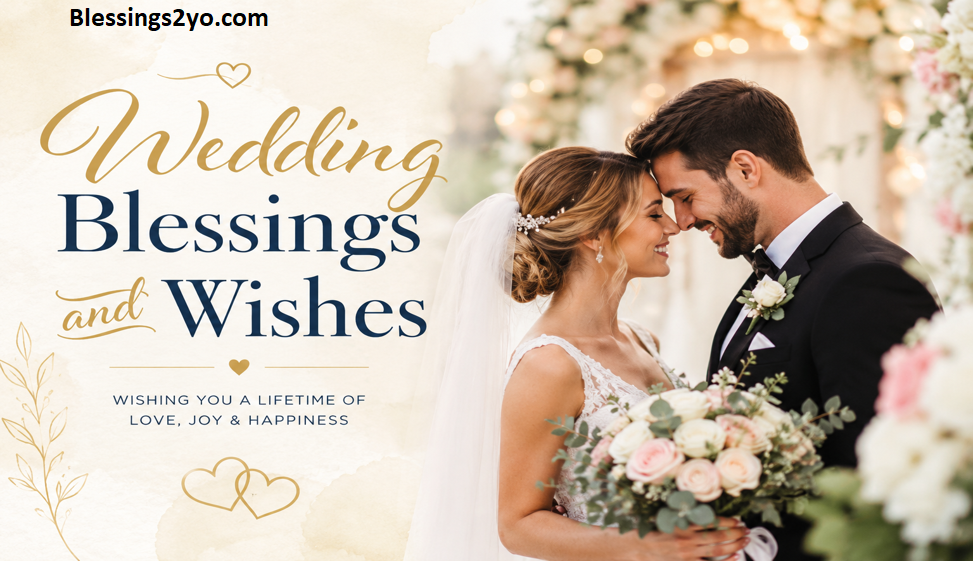
Wedding Blessings fill this sacred day with love, joy, and hope for the beautiful journey ahead. As two hearts become one, may their union be blessed with unwavering trust, deep companionship, and endless laughter.
May their home be filled with peace, their marriage rooted in faith, and their love grow stronger with each passing year. Through life’s joys and challenges, may they always find strength in each other and comfort in God’s grace.
Wedding Blessings to this beautiful couple — may your love story inspire all who witness it, and may every day together be a testament to the beauty of true, lasting love.
Table of Contents
Quick Table
| Sample Title |
|---|
| Wedding Blessings: 30 Heartfelt Prayers for the Bride & Groom |
| Wedding Blessings You Need to Hear on Your Big Day (Beautiful) |
| Wedding Blessings & Wishes for a Lifetime of Love |
| Wedding Blessings: Speak This Over the Newlyweds’ Future |
| Wedding Blessings for a Beautiful Union: Love, Joy & Harmony |
| Start Their Marriage Right: Wedding Blessings & Prayers |
| A Toast of Love: Wedding Blessings to Bless Their Journey |
How I Learned to Write a Meaningful Wedding Blessing
Three years ago, my cousin asked me to say a few words at her wedding. Not a full speech — just “a little blessing, nothing fancy.” I said yes without thinking twice.
Then I sat down the night before with a blank notebook page and completely froze.
Turns out “just a little blessing” is one of the hardest things to write. It has to be short, it has to feel personal, and it has to land in a room full of people who are already crying over the cake-cutting playlist. I ended up rewriting mine four times, and I still remember stumbling over the word “cherish” in front of eighty people.
Since then I’ve written blessings for two more weddings, helped a friend pick one for her card, and read way too many wedding forums at 1 a.m. So here’s everything I actually learned — the useful stuff, not the greeting-card fluff.
What a Wedding Blessing Actually Is (and Isn’t)
People mix this up constantly. A wedding blessing isn’t a speech. It’s not a toast either.
A speech tells a story — usually funny, usually with an embarrassing anecdote about the groom’s college years. A toast is the “raise your glass” moment. A blessing is quieter than both. It’s a short wish or prayer for the couple’s future, usually 3-6 sentences, and it can be read aloud, written in a card, or even printed on a wedding program.
Some are religious (“May God bless your union with patience and joy”). Some are completely secular (“May your home always have more laughter than silence”). Both are valid. Nobody’s checking your theology at the door.
My First Attempt (and Why It Flopped)
My first blessing was basically a Pinterest quote with my cousin’s name swapped in. It sounded fine on paper but felt hollow the second I said it out loud, because it could’ve been for literally any couple.
The groom’s grandmother, sweet as she was, leaned over to my aunt afterward and said, “That was nice, whose wedding was that for again?” Ouch. Lesson learned the hard way.
The blessings that actually make people tear up are the specific ones. Not “may you have a lifetime of happiness” — anyone can say that about anyone. Something like “may your kitchen always smell like the terrible garlic bread Sam burned on your first date” hits completely differently, because it’s theirs.
How I Write One Now (Step by Step)
1. Steal one real detail about the couple. Not their wedding date or venue — an actual quirk. How they met, an inside joke, a shared hobby, even a pet. This becomes your anchor line.
2. Pick a structure and stick to it. Most good blessings follow a simple shape:
- A line acknowledging the moment (“On this day…”)
- A wish for their future together
- A closing line that ties back to something personal
That’s it. Three beats, not a novel.
3. Read it out loud before you write it down. This sounds backwards but it works. Say your wish in plain conversation first — like you’re texting a friend, not writing calligraphy. Then tighten it up. Blessings that read beautifully on paper often sound stiff when spoken.
4. Cut anything you wouldn’t actually say to their face. If a line makes you cringe reading it back, the room will feel that cringe too.
5. Time it. Read it out loud with a stopwatch. Anything over 60-90 seconds starts losing the room, especially if you’re not the only one speaking that night.
A Few Real Examples I’ve Actually Used
For my cousin (second attempt, after the flop): “May your home have room for growth, forgiveness, and hard laughing on ordinary Tuesdays. You found each other during the most boring years of a pandemic — may the next fifty be far more interesting.”
For a coworker’s card, secular and short: “Wishing you the kind of love that gets more comfortable, not less exciting.”
For a religious ceremony (Christian, since that’s what the couple asked for): “May the Lord walk with you both — through the ordinary days as much as the joyful ones — and may your marriage always be a place of grace for each other.”
None of these are fancy. That’s kind of the point.
Common Mistakes I See (and Made Myself)
Making it about you. I’ve sat through blessings that turned into 5-minute stories about the speaker’s own marriage. It’s sweet in a toast; it’s off in a blessing. Keep the focus on the couple.
Borrowing a quote wholesale. Nothing wrong with being inspired by something you found online — I use Pinterest and even Etsy listing descriptions for inspiration sometimes — but if you’re just copy-pasting a generic verse, people can tell. Tweak it, add a name, add a detail.
Ignoring the religious context. If it’s a Catholic mass, don’t wing a purely secular line — check with the couple or officiant first. I once assumed a friend wanted something spiritual because her mom was religious, and she quietly told me afterward she’d have preferred something simpler. Ask first if you’re not sure.
Overwriting it. Longer isn’t more heartfelt. I promise the room remembers “may your love only grow” more than a three-paragraph blessing that name-drops five relatives.
Forgetting to write it down somewhere safe. I once had mine saved only in my Notes app, and my phone died mid-reception before the ceremony reading. Now I always print a backup copy or email it to myself the morning of.
Tools That Actually Helped Me
I’m not big on “wedding blessing generator” websites — most spit out the same generic template with your names swapped in, and it shows. But a few things genuinely helped:
- Notes app or Google Docs for drafting and rewriting without losing versions.
- Voice memos to record myself reading it aloud and check the pacing.
- Canva, if you want to actually print or frame the blessing as a keepsake for the couple — some people turn a written blessing into a small framed print as a gift, which I’ve done twice and it’s always well received.
- Asking the officiant directly if there’s a religious ceremony involved — they’ve usually seen hundreds of these and can tell you what tone fits.
If You’re Picking a Blessing for a Card, Not Writing Your Own
Sometimes you just need a line for a wedding card and don’t want to write an original one. That’s completely fine — most people do this. Just avoid the most overused ones (“two souls, one heart” shows up on approximately every card at every wedding shop). Add one personal sentence before or after it so it doesn’t feel copy-pasted, even if the core line isn’t your own.
FAQ’s
What are Wedding Blessings?
Wedding blessings are heartfelt prayers, wishes, or words of encouragement offered to a couple on their wedding day. They express hope for a lifelong marriage filled with love, faith, and happiness.
Who can give a wedding blessing?
Anyone can offer a wedding blessing — family members, friends, officiants, or guests. Blessings can be spoken during the ceremony, written in a card, or shared in a toast at the reception.
What makes a good wedding blessing?
A good wedding blessing is sincere, personal, and uplifting. It often includes wishes for love, unity, strength, and lasting happiness, and may reflect the couple’s faith, values, or shared journey.
Can wedding blessings be non-religious?
Yes. While many blessings have spiritual roots, they can easily be adapted into heartfelt, non-religious messages focused on love, partnership, and well-wishes for the couple’s future.
When is the best time to share a wedding blessing?
Wedding blessings are commonly shared during the ceremony, in a wedding card, or as part of a toast at the reception — any moment that feels meaningful to the couple.
Conclusion
Wedding Blessings hold a special place in celebrating one of life’s most meaningful milestones.
They carry the weight of love, hope, and heartfelt wishes for a couple beginning their journey together as one. Whether spoken during the ceremony, written in a card, or shared as a toast, these blessings offer encouragement that can strengthen a marriage for years to come.
They remind the couple that they are supported, loved, and surrounded by people who wish them nothing but happiness. In a world where relationships face many challenges, wedding blessings serve as a beautiful reminder of faith, commitment, and enduring love.
As you celebrate this joyous occasion, take a moment to offer your own blessing — whether through words, prayer, or simple well-wishes. May every couple who receives these blessings build a marriage rooted in trust, laughter, and unconditional love, today and for all the years to come.